The New Learning Stack: People, Platforms and Intelligent Tools
Institutions tend to buy a platform to solve a teaching problem, or an AI tool to solve a content problem. The learning stack works when each layer does its own job and the layers share what they know.
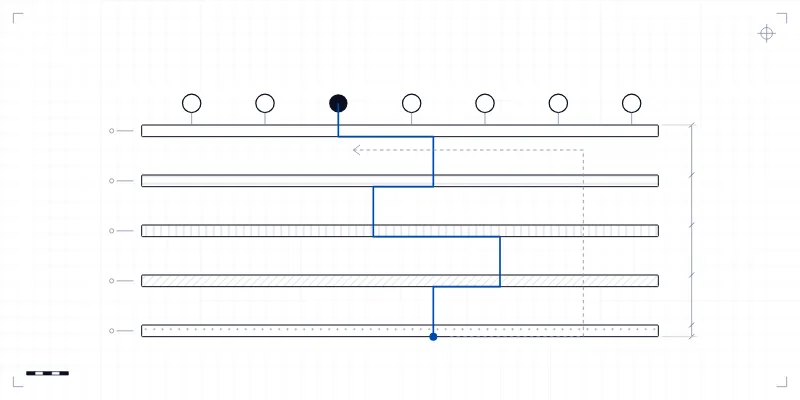
Software engineers talk about stacks: the layers of technology that together make a system work, each with a defined responsibility and defined interfaces to the layers around it. The idea is useful beyond software. It helps explain why some learning environments work and others, often more expensive ones, do not.
A modern learning environment has several layers. There are people: instructors, mentors, peers. There are platforms that handle enrolment, scheduling, materials and records. There is content, in every format. There are, increasingly, AI assistants that explain, generate practice and respond to questions. There is assessment, which establishes what someone can do. And there are analytics, which try to make sense of all the activity.
Each layer is good at some things and poor at others. Problems tend to arise when an institution expects one layer to do another's job.
People are the layer that cannot be replaced
It is worth starting with the layer that technology discussions often skip. Instructors, mentors and peers provide things no other layer does well: judgement about what matters, recognition of subtle misunderstanding, motivation through the difficult stretches, and a sense of what good work looks like in practice.
This layer is also the most expensive and the least scalable, which is why so much education technology is framed as a way of reducing dependence on it. That framing is understandable and often mistaken. The better question is not how to replace human teaching but how to spend it well: on the interactions where judgement matters most, rather than on the tasks that other layers can handle.
A teacher who spends hours answering the same routine questions, marking multiple-choice quizzes and chasing attendance has less time for the conversations that actually change how a student thinks. Technology that takes over the routine work is valuable precisely because it frees the human layer for what only it can do.
Platforms handle logistics, not learning
Learning management systems and similar platforms are good at organisation. They enrol students, distribute materials, schedule sessions, collect submissions and keep records. For an institution running many courses across many cohorts, that is essential infrastructure.
What platforms do not do, on their own, is teach. An institution that buys a platform expecting learning outcomes to improve is often disappointed, because the platform has made the logistics smoother while leaving the teaching exactly as it was. The platform is a foundation for the other layers, not a substitute for them.
There is one important exception. Platforms that provide practice environments, places where learners can do the thing they are learning under realistic conditions, begin to cross into teaching. A simulation, a coding sandbox, a virtual laboratory or a market environment with virtual capital gives learners direct feedback on their actions. That is closer to learning than any materials repository, and it is one of the places where platforms add the most value.
A platform can make the logistics of teaching smoother while leaving the teaching exactly as it was.
Content is abundant; sequence is scarce
For most subjects, good explanatory content already exists, often freely. The difficulty is no longer finding material but choosing it, putting it in a sensible order, and connecting it to what the learner already knows and needs next.
That work, curation and sequencing, is a distinctly human contribution, and it is frequently undervalued. A well-chosen sequence of modest materials can teach better than a comprehensive library of excellent ones, because it tells learners what to look at and in what order. Institutions and instructors who invest in sequence, and in connecting content to practice, often get more from existing material than from commissioning new material.
AI assistants need boundaries set by teachers
AI assistants are the newest layer and the one generating most attention. Their strengths are real. They explain concepts on demand, at the learner's level, as many times as needed. They generate practice questions and worked examples. They answer questions at hours when no instructor is available.
Their weaknesses are also real, and they matter more in education than in most other settings. Assistants can be confidently wrong, which is dangerous for learners who cannot yet tell the difference. They can supply answers that remove the productive struggle through which learning happens. And they do not, on their own, know what a particular course is trying to achieve.
This is why the AI layer works best when the human layer configures it. Instructors are in the best position to decide what an assistant should help with and what it should decline. Should it explain concepts but not solve assigned problems? Should it give hints before answers? Should it draw only on course materials? These are pedagogical decisions, and they should be made by teachers rather than left to the defaults of a general-purpose tool. We discuss the engineering side of placing AI inside larger systems in AI as a layer in software. The same logic applies here with higher stakes.
Assessment has to change shape
The arrival of capable AI assistants has put pressure on assessment in a way that is hard to overstate. Take-home essays, problem sets and many forms of written work can now be completed with substantial AI help, and detecting that help reliably is difficult.
The more durable response is not better detection but different assessment. Forms of assessment that observe performance directly are much harder to outsource: practical tasks completed in controlled settings, projects built over time with visible progress, oral examination and discussion of the learner's own work, and live exercises under realistic conditions. These forms also tend to measure what matters more accurately, because they show what someone can do rather than what they can produce given unlimited assistance.
Assessment also needs to be trustworthy outside the institution. As learning becomes more continuous and happens in more places, credentials that can be verified against the issuer's records become more valuable than ones that simply assert completion.
Analytics should serve decisions
Every layer of the stack generates data, and the analytics layer tries to make sense of it. The most common failure here is building dashboards that describe activity in great detail without helping anyone decide anything.
Useful learning analytics start from a decision someone needs to make. Which students need attention this week? Which part of the course is causing the most difficulty? Is the new practice exercise helping? Analytics designed around questions like these tend to be simpler and more useful than analytics designed around the data that happens to be available. They also respect the limits of what data can show. Time spent and pages viewed are measures of activity, and it is easy to mistake them for measures of learning.
Learning is social, and the stack should allow it
Much of what people learn, they learn from each other: by discussing problems, comparing approaches, explaining things to peers and seeing how others work. Learning environments that treat each learner as an isolated individual working through content lose much of this.
Supporting it does not require elaborate technology. It requires cohorts that move through material together, spaces for discussion, group work built into assessment, and instructors who encourage collaboration rather than treating it as a threat to integrity. The stack should make these easier, not harder.
Institutions and professionals need different stacks
The same layers appear in university education and in professional development, but the constraints differ. Institutions work within accreditation requirements, academic calendars, large cohorts and assessment that must be defensible. Professionals learn around their work, with limited time, specific immediate needs and little patience for material that is not relevant.
A learning stack for institutions needs strong administration, rigorous assessment and support for structured sequences. A stack for professionals needs flexibility, entry at the point of need and a close connection to real work. Tools designed for one context often fit the other poorly, and institutions increasingly need to serve both, as their students continue learning long after graduation.
The layers have to talk to each other
Finally, a stack only works if its layers share information. A learner who needs separate logins for the platform, the practice environment, the AI assistant and the assessment system is working against the infrastructure. An instructor who cannot see, in one place, how a student is doing across all of those cannot use that information to help.
Integration is not the most interesting part of learning technology, but it frequently determines whether the rest works. Shared identity, shared records and a consistent view of each learner's progress turn a collection of tools into an environment.
Balance, not replacement
The recurring lesson is balance. Technology is very good at logistics, at providing practice environments, at making content available, at answering routine questions and at surfacing patterns in data. People are essential for judgement, motivation, sequencing, assessment of real capability and the social life of learning. The best environments assign each layer the work it does well and connect them carefully.
That is the approach we are taking with AlphaSync Campus, a learning and simulation environment for universities and colleges that is currently in development. It is designed to bring curriculum, practice on market data with virtual capital, and assessment together, with instructors setting the direction. Our College Workshop Programme, led by practitioners and run on AlphaSync's simulation foundation, reflects the same balance today: technology for practice, people for teaching.